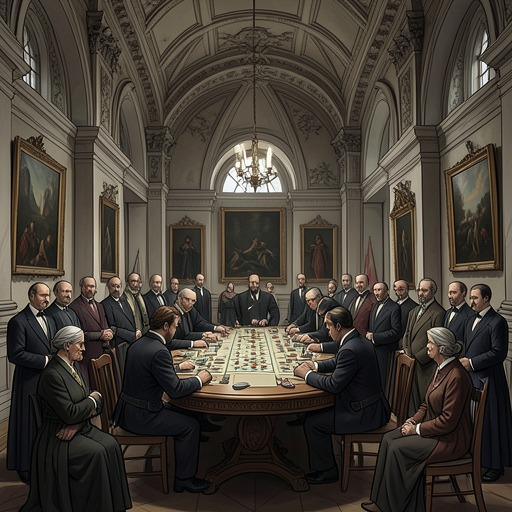
Rediscovery of Bach manuscripts
The Glass Bead GameThe rediscovery of eleven manuscripts by Johann Sebastian Bach, kept by his son Friedemann, is presented as a remarkable accident that seemed to answer a culture’s fear of decline. More than a recovery of musical works, it becomes an emblem of how patient scholarship and fidelity to tradition can preserve the possibility of renewal.
Background: A Culture in Decline
The episode is set against the transition from the Age of the Feuilleton, when cynicism and gloomy predictions of the collapse of art, science, and language were widespread. Yet beneath this apparent capitulation, a few individuals and small groups remained committed to preserving disciplined methods and rigorous intellectual work. Their resistance was quiet rather than triumphant: they sought to retain a core of tradition for the future.
Music history was one focus of this effort. The discipline was reaching a high point, and two renowned seminaries maintained exemplary standards of care and thoroughness even within the surrounding culture of decline. The discovery of Bach’s manuscripts arrives within this account not as an achievement planned by the scholars, but as a contingent event that seemed to reward the intellectual seriousness they had maintained.
The Discovery and Its Meaning
The manuscripts had been in the keeping of Bach’s son Friedemann. Their rediscovery is described as a glorious miracle that was “in itself pure chance,” yet appeared to offer “a divine corroboration” to the small cohort working to sustain cultural life. The narrator does not claim that the accident proves a providential design; rather, the contrast between chance and apparent confirmation gives the event its force.
The manuscripts also make visible the precariousness of cultural memory. The account recalls how a creator’s work can be neglected, misattributed, or later subjected to misunderstanding. In the case of Bach, the survival and recovery of his music matter because a body of work and the life of its creator are understood by the historian as inseparable parts of a living unity. Rediscovery thus restores not only manuscripts but a fuller relation between artistic creation, historical memory, and later interpretation.
Cultural Resistance and Legacy
The event belongs to a broader pattern of resistance to degeneration. Alongside scholarly music history, the League of Journeyers to the East cultivated spiritual discipline and reverence, contributing contemplative elements to the later Glass Bead Game. Its musicians sought to perform older music in the style of its own age, resisting the contemporary fixation on dramatic dynamics and virtuoso display. These efforts show that cultural preservation involved both exacting study and renewed modes of attention.
The Bach manuscripts’ recovery condenses that larger history into a single striking occurrence: an accidental survival becomes a source of hope for people working carefully against cultural forgetting. Its significance lies not in guaranteeing renewal, but in showing how recovered inheritance can strengthen the belief that a culture may examine its decline and begin again.